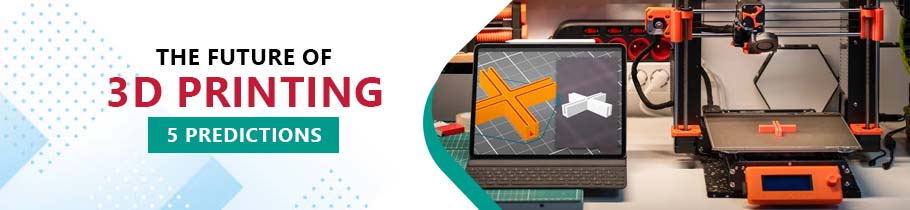
Not too long ago, 3D printing was considered a niche hobby for tech enthusiasts and rapid prototyping labs. Today, additive manufacturing has evolved into an industrial powerhouse, altering how products are designed, sourced, and manufactured worldwide. As we push deeper into a highly automated era, the boundaries of this technology are expanding faster than ever before.
Just as traditional marketing evolved by utilizing high-end Digital Printing to offer on-demand physical customization, manufacturing is undergoing its own digital revolution. Looking ahead, here are 5 major predictions that will define the future of 3D printing technology over the next decade.
How Additive Manufacturing Will Reshape Global Industries
The conversation around 3D printing has officially shifted from *if* it belongs in full-scale production to *how deeply* it can be integrated into daily operations. From AI-driven design software to multi-material outputs, these advancements are moving additive setups directly onto mainline production floors, rendering old manufacturing limits completely obsolete.
1. From Prototyping to Mainline Mass Production
Historically, 3D printers were reserved for creating early-stage visual models or rough mockups. The future, however, belongs to full-scale, end-use components. Thanks to major breakthroughs in machine throughput and mechanical process stability, heavy industries like aerospace and automotive are integrating industrial 3D platforms directly into their assembly chains. This allows companies to manufacture complex, lightweight parts on demand without relying on rigid traditional tooling.
2. Supply Chain Redesign via Digital Inventories
Global supply chains remain highly vulnerable to geopolitical conflicts, shipping delays, and soaring warehouse costs. 3D printing will play a critical role in solving these vulnerabilities by shifting businesses toward localized, distributed production networks. Instead of stocking physical spare parts in massive warehouses, companies will store certified digital files. When a part is needed, it can be printed locally near the point of use, making the entire logistics model incredibly resilient.
3. Multi-Material and Full-Color Complexity
The days of printing single-colored, uniform plastic models are rapidly coming to an end. Next-generation systems are prioritizing multi-material printing, allowing a single machine to combine soft elastomeric rubbers, rigid polymers, and full-color textures in a single continuous build. This capability will revolutionize consumer electronics and medical devices, enabling the production of items with integrated circuitry or perfectly customized physical properties tailored to individual human anatomy.
4. AI-Powered Print Optimization and Zero Waste
Artificial Intelligence is completely transforming the pre-production and active slicing stages of 3D printing. Advanced machine-learning algorithms can now optimize geometric designs to maximize structural strength while minimizing raw material usage. Furthermore, AI-enhanced sensors can predict print failures or shifts in layer alignment before they happen, adjusting parameters in real-time. This cuts down on print failures and reduces waste material down to almost zero.
5. Re-imagining Construction and Eco-Friendly Materials
Sustainability is no longer a luxury choice—it is a regulatory and corporate necessity. The future of 3D printing will be heavily anchored in bio-based compounds, plant-derived resins, and highly recyclable filament blends. On a grand scale, large-format concrete 3D printing is completely redefining urban development by allowing architectural firms to print eco-friendly, energy-efficient housing components directly on site, dramatically lowering construction timelines and manual labor requirements.
The Corporate Visual Connection: Blending Additive with Traditional Branding
As 3D printing revolutionizes how products are manufactured, the physical spaces used to display these innovations must look equally cutting-edge. To see how different manufacturing and promotional assets compare in a physical corporate matrix, look at how they elevate a brand’s presence:
| Corporate Display Asset | Role in the Industrial Landscape | Traditional Counterpart / Printing Need |
|---|---|---|
| 3D Printed Prototypes | Demonstrates structural mechanics, internal components, and direct product design functionality. | Requires pristine high-volume documentation printed via an Offset Printing press for investor catalogs. |
| Corporate Exhibition Booths | Acts as the live presentation floor where physical 3D innovations are showcased to global investors. | Built flawlessly by partnering with an expert Exhibitions supplier. |
| Large-Scale Site Graphics | Captures localized attention around massive manufacturing hubs, facilities, or construction grounds. | Requires heavy-duty outdoor assets like unmissable urban Hoarding or weathered banners. |
| Storefront Signage | Establishes the permanent physical address and corporate authority of the technology firm. | Relies on a custom-built, highly vibrant Sign Board paired with heavy-duty Flex Printing elements. |
Conclusion
The future of 3D printing holds immense promise, shifting the world away from static, centralized factories toward fluid, decentralized digital networks. As machines become faster, materials become more diverse, and AI handles optimization, additive manufacturing will unlock unprecedented levels of creative freedom and operational efficiency. For businesses looking to thrive in the coming decades, embracing this manufacturing evolution will be the ultimate key to staying competitive and resilient.